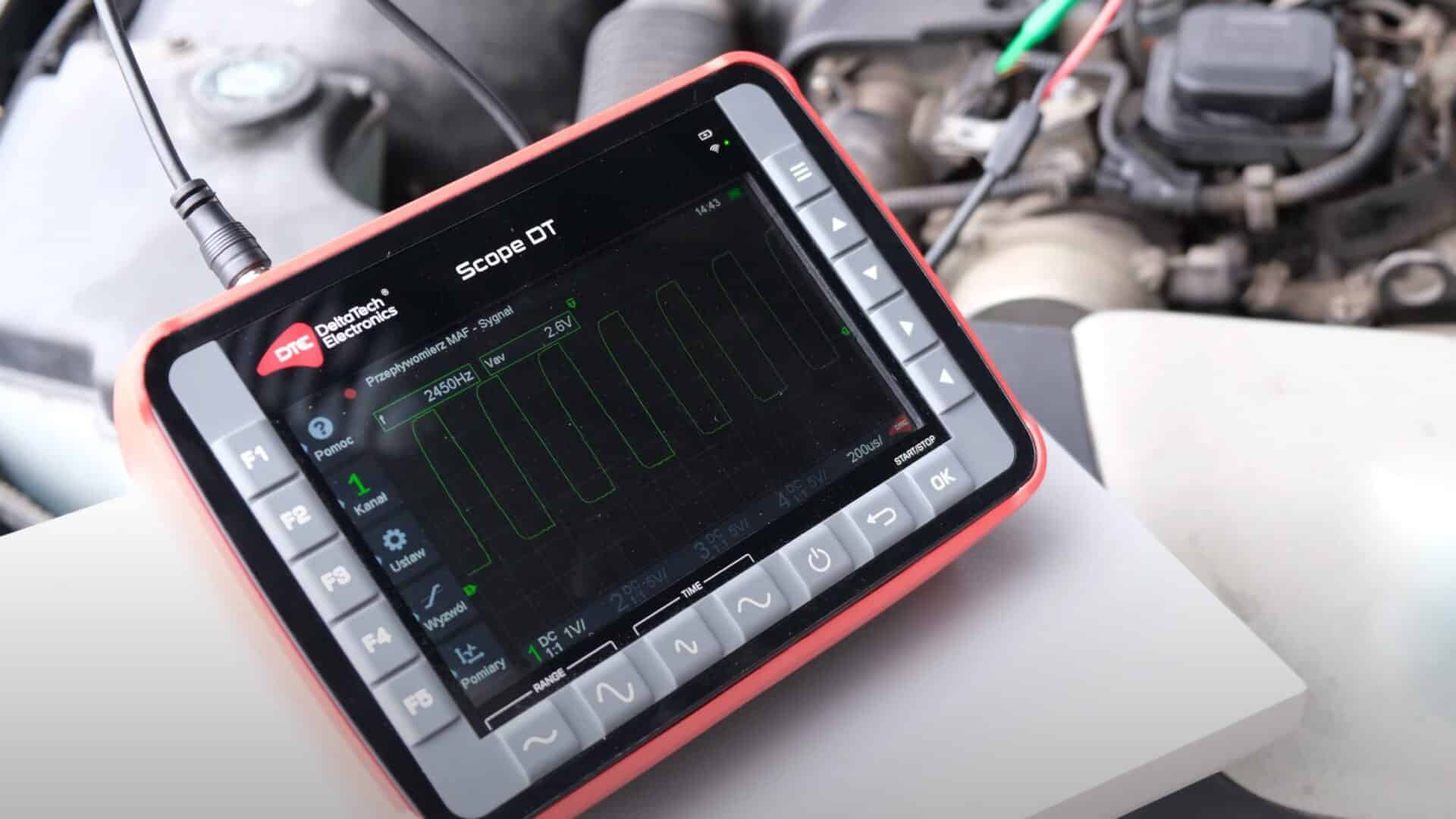

If your scan tool says everything’s fine but the car still acts up, you already know the feeling – something’s wrong, you just can’t see it yet. That’s exactly the gap a professional automotive oscilloscope fills.
What is a professional automotive oscilloscope for vehicle diagnostics
A modern car is essentially a mobile electronic laboratory. Dozens of sensors, control units, and actuators exchange signals hundreds of times every second. This is where a professional automotive oscilloscope for vehicle diagnostics comes in. It captures electrical signals in real time and displays them as waveforms. This allows you to see exactly what’s happening in the circuit instead of just confirming that something is wrong.
A professional automotive oscilloscope for vehicle diagnostics is the tool that fills that gap. Where a scanner reads what the ECU thinks is happening and a multimeter gives you a single frozen value, an oscilloscope shows you the live electrical signal — as it actually behaves over time, not averaged, not filtered, not interpreted. That distinction matters more than it sounds. For anyone diagnosing modern vehicles seriously, it’s the difference between understanding a fault and guessing at it.
How an automotive oscilloscope for cars works
The principle is simple. The device measures voltage at a high frequency and creates a graph of how it changes over time. This graph immediately shows things a multimeter will never catch – a sensor signal that looks fine while stationary but fails under load, a crankshaft sensor that drops out for two milliseconds, or a fuel injector that fires late.
An automotive oscilloscope for cars connects to the circuit using clips that don’t disrupt the circuit. The device samples the voltage at intervals determined by its sampling rate. A higher frequency provides more detail for fast processes – like CAN bus frames or ignition system events.
The samples form a waveform where the horizontal axis represents time and the vertical axis represents voltage. A healthy throttle position sensor produces a smooth, rising line as you press the pedal. A worn sensor shows steps, spikes, or dropouts that no static measurement will record. For anything that happens faster than a few milliseconds – which is almost every system in modern engine management – the oscilloscope is the only tool that provides the full picture.
Key features of a professional car diagnostic oscilloscope
Not every oscilloscope is designed for a repair shop, and you can feel the difference in practice. A professional car diagnostic oscilloscopeusually has these characteristics:
● Multiple channels – standard models have 2-4 channels, though some have more. More channels mean fewer reconnections and the ability to capture how systems interact in a single test.
● High sampling rate – professional models sample at 10 MS/s or faster. This ensures a clear display of fast events like CAN bus frames or piezo injector signals.
● Recording and saving signals – the ability to save waveforms for later review, compare dynamic sessions, or share results with colleagues.
● PC or laptop connection – most professional tools connect via USB and run on specialized Windows software. This provides a large screen and regular updates.
● Automotive software – high-quality diagnostic software comes with a library of reference waveforms, step-by-step test procedures, and analysis tools designed specifically for vehicle electronics.
When choosing a model, you should also look at the quality of the probes, cable length, and whether it has a built-in battery. These practical details affect how easy the tool is to use every day.
Automotive diagnostic tools oscilloscope vs other diagnostic tools
Every shop has an OBD-II scanner, and every technician has a multimeter. Both are essential, but neither can replace an oscilloscope.
An OBD-II scanner reads fault codes and data streams from the ECU. It shows what the computer thinks is wrong based on the values it receives. The problem is that a sensor that produces a normal average value but has chaotic spikes between measurements will pass a scanner check without any issues.
A multimeter measures voltage, resistance, or current at a specific moment. It works well for checking power and ground, testing relays, or testing a component off the car. However, it can’t show a signal that only exists for five milliseconds out of every hundred.
Among automotive diagnostic tools oscilloscope work at a completely different resolution level. It captures the real electrical picture. For modern cars with complex electronics, this is what separates real diagnostics from guesswork.
Common Automotive Systems Diagnosed with an Oscilloscope
On a modern vehicle, you can use this professional tool to check:
● Ignition system – primary and secondary waveforms reveal the condition of coils, spark plugs, and combustion quality better than any other tool.
● Fuel system – injector opening time, needle bounce, and rail pressure reaction provide a full picture of fuel delivery during a cycle.
● Engine sensors – crankshaft and camshaft sensors, mass air flow sensors, oxygen sensors, and knock sensors. Each has a specific waveform, and deviations point directly to a fault.
● Injectors – analyzing current flow on direct injection systems allows you to find internal wear or deposits without removing the parts for a bench test.
● Electronic control units – CAN bus traffic, LIN bus signals, and module wake-up sequences help locate communication failures that a scanner records but can’t pinpoint.
If you add ABS sensors, alternator diode bridges, starter current during cranking, and variable valve timing actuators, the list covers nearly every electrical function on the car.
Summary
A professional oscilloscope is one of the few diagnostic tools that truly deserves a permanent spot in any serious shop. An automotive oscilloscope for cars turns abstract electrical behavior into something visible and measurable. Intermittent faults stop being a mystery. For any shop that diagnoses vehicles deeper than just reading codes, investing in a high-quality oscilloscope pays off quickly – in the confidence that you truly understand what’s happening with the vehicle.
FAQ
What is a professional automotive oscilloscope used for?
It captures and displays electrical signals as real-time waveforms. It’s especially useful for faults that don’t trigger a code or only appear under specific driving conditions.
How does an automotive oscilloscope for cars work?
The device connects to a circuit using probes, measures voltage at a high frequency, and builds a graph on a time-voltage scale. This allows you to see signal quality, timing characteristics, and any deviations that are invisible during static measurements.
Is a professional car diagnostic oscilloscope better than a standard scanner?
A scanner reads codes and averaged data from the ECU, while an oscilloscope captures raw, high-resolution waveforms. An oscilloscope goes much deeper and finds problems a scanner simply cannot see.
Why is an automotive diagnostic tools oscilloscope important for modern vehicles?
Modern cars run on high-speed digital and analog signals that OBD-scanners and multimeters can’t fully analyze. An oscilloscope captures these signals with the necessary resolution and allows you to find faults that would otherwise be impossible to locate.